|
Rebecca’s Ninth Newsletter!͏ ͏ ͏ ͏ ͏ ͏ ͏ ͏ ͏ ͏ ͏ ͏ ͏ ͏ ͏ ͏ ͏ ͏ ͏ ͏ ͏ ͏ ͏ ͏ ͏ ͏ ͏ ͏ ͏ ͏ ͏ ͏ ͏ ͏ ͏ ͏ ͏ ͏ ͏ ͏ ͏ ͏ ͏ ͏ ͏ ͏ ͏ ͏ ͏ ͏ ͏ ͏ ͏ ͏ ͏ ͏ ͏ ͏ ͏ ͏ ͏ ͏ ͏ ͏ ͏ ͏ ͏ ͏ ͏ ͏ ͏ ͏ ͏ ͏ ͏ ͏ ͏ ͏ ͏ ͏ ͏ ͏ ͏ ͏ ͏ ͏ ͏ ͏ ͏ ͏ ͏ ͏ ͏ ͏ ͏ ͏ ͏ ͏ ͏ ͏ ͏ ͏ ͏ ͏ ͏ ͏ ͏ ͏ ͏ ͏ ͏ ͏ ͏ ͏ ͏ ͏ ͏ ͏ ͏ ͏ ͏ ͏ ͏ ͏ ͏ ͏ ͏ ͏ ͏ ͏ ͏ ͏ ͏ ͏ ͏ ͏ ͏ ͏ ͏ ͏ ͏ ͏ ͏ ͏ ͏ ͏ ͏ ͏ ͏ ͏ ͏ ͏ ͏ ͏ ͏ ͏ ͏ ͏ ͏ ͏ ͏ ͏ ͏ ͏ ͏ ͏ ͏ ͏ ͏ ͏ ͏ ͏ ͏ ͏ ͏ ͏ ͏ ͏ ͏ ͏ ͏ ͏ ͏ ͏ ͏ ͏ ͏ ͏ ͏ ͏ ͏ ͏ ͏ ͏ ͏ ͏ ͏ ͏ ͏ ͏ ͏ ͏ ͏ ͏ ͏ ͏ ͏ ͏ ͏ ͏ ͏ ͏ ͏ ͏ ͏ ͏ ͏ ͏ ͏ ͏ ͏ ͏ ͏ ͏ ͏ ͏ ͏ ͏ ͏ ͏ ͏ ͏ ͏ ͏ ͏ ͏ ͏ ͏ ͏ ͏ ͏ ͏ ͏ ͏ ͏ ͏ ͏ ͏ ͏ ͏ ͏ ͏ ͏ ͏ ͏
Hi Plant People,Happy Flower Moon! It’s our moon! It’s the time when those of us in the northeast can barely function what with the dizzying beauty and perfumes of the flowers around us. It can feel somehow frivolous these days to care for plants, when people are being harmed and fascism is on the rise. Still, I continue to feel that this work is important, if not only to provide respite to those working for justice. — Spring bird migration is in full tilt in the northeast. Remember to turn off outdoor lights so that birds do not get disoriented. New research shows that Monarchs are also confused by nighttime lights, mistakenly attempting to migrate at night. Similarly, hawkmoths use the full moon to navigate and only by accident exhaust themselves at your porch light. If you must keep lights on at night, please use a warm-toned LED bulb. — The new BBP Mulch Guide was featured in the New York Times! Margaret Roach wrote an excellent and comprehensive column on mulch and how to use it, and how not to. Piet Oudolf once said to me “Americans like to display their mulch” which is embarrassingly true. Why, America? Why?
|
|
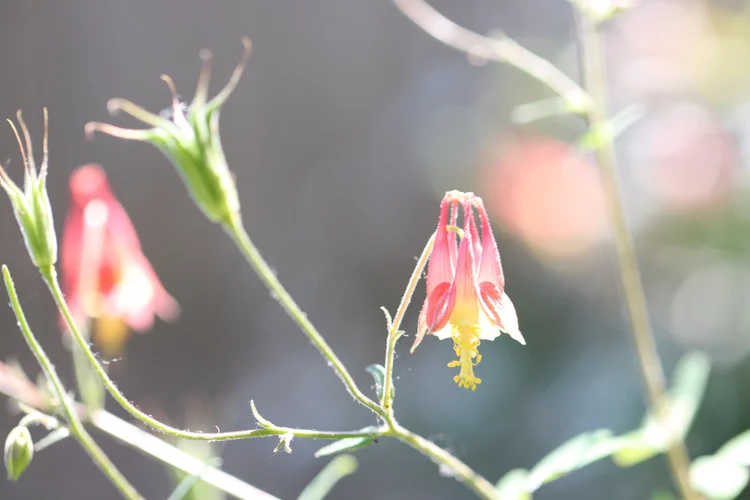
My favorite thing about flowers blooming is knowing who they call to. In the northeast, Ruby Throated Hummingbirds are finally returning after overwintering in Mexico and Central America. As they fly over the land, they’re greeted with red flowers blooming just for them. Hummingbirds see red better than humans, but more importantly, far better than bees. Bees have trouble differentiating between red and green, so red flowers are often hidden from them, leaving reds for the birds. As hummingbirds migrate, a wave of blooming red flowers moves with them, like a red carpet welcoming them north. Our Eastern Columbine is a joy to see in the spring, a true beauty, but how marvelous to recognize that its bloom heralds the return of these birds! The Columbine flower has painstakingly crafted itself over thousands of years to partner with the Ruby Throated Hummingbird, hiding their nectar away atop long spurs, to be drunk by only the longest of tongues. When hummingbirds hover, inserting their beak into the spur, flowers bush their throats with pollen, hoping that the bird will fly it to another receptive Columbine. — A very different, and no less elegant dance happens within our Jack-in-the-Pulpits, still blooming in Brooklyn. These flowers are pollinated by fungus gnats, tiny flies that are lured into the flowers to pollinate them … TO DEATH!!!! Yes, the Arisaema are the only known flowers that kill their pollinators. It’s an odd evolutionary tactic to say the least, but it seems to work well in part due to new research that makes this whole situation even more awkward: the innocent gnats are enticed into the “pulpit” with sex! Yes, the flowers mimic the smell of a hot, nubile female gnat and the males head right in, trapped forevermore in what you can imagine is a confusing situation. It’s all laid out in lurid detail in this delightful article. — Spring ephemerals have started to go to seed and you know what that means, Myrmecochory! Yes, the distribution of seeds by ants, who we all have to thank for Bloodroot, Hepatica, and Trillium. These plants produce fatty tissues on seeds that the ants love to eat while inadvertently planting them. Here is a short, adorable video with footage of this happening.
|
Here is a truly incredibly resource for weed management: it’s a free 300 page PDF that covers weed ecology and IPM strategies exhaustively. The bindweed section alone is just incredible. Thanks forever to Thomas Christopher who interviewed one of the authors on his marvelous podcast. Native plant sage, Uli Lorimer wrote a book! The Northeast Native Plant Primer looks incredible. Order here. An updated and incredible Flora of the Southeastern United States has been published for free online. Thank you Alan Weakley.
|
A wonderful piece in the NYT on a wonderful man’s wonderful garden! James Golden’s Federal Twist was featured by Margaret Roach, delving into the origin and evolution of the place. I love the idea that you shouldn’t fight the land, or it will fight back. You can learn more about it here, or you can just buy his beautiful new book! Researchers successfully grew plants in moon “soil!!!! Technically the lunar medium is called “regolith” and technically, we should be saving our own planet rather than galavanting around the solar system. But still, so cool. Better Homes & Gardens put Harry Styles on the cover of their June magazine and their Instagram followers have absolutely MELTED DOWN. There are two very passionate, very serious groups of (seemingly) white ladies having an all out flame war in the comments section about whether or not Styles deserves to be there. It’s either a fun, novel break from embroidered pillows or, alternately, outright sacrilege and somehow “woke.” Interestingly, there doesn’t seem to be an age delineation: proud grandmas have defended Styles’ cuteness while young ladies have deemed it “cringe.” One photo seems to have garnered the additional controversy of questionable styling. It features (and you’re welcome in advance) Harry in his underwear, in a pulled up duck sweater, lying in a dirty puddle or, as commenters accuse, “a ditch.” Which… everyone has different taste, but I prefer to see this as a statement on the ridiculous ways women have been posed for decades. I googled “sexy woman dirty puddle” and got >8 million hits sooo… Anyway, I’m here for all of it. An update and history of the fight to save Bell Bowel Prairie. It would have been paved by now if it weren’t for the presence of the Rusty Patch Bumble Bee, illustrating the critical nature of Endangered Species designations. Please, for real, take action to save the prairie. Speaking of, 140 groups are petitioning the Biden Administration to restore scientific integrity to the agency that designates endangered species, the US Fish and Wildlife Service. I imagine it’s hard ask, given that the Dept seems more focused on killing millions of animals. Even if one could rationalize killing native animals who “interfere” with agriculture, there has to be a safer, more ethical strategy than using cyanide bombs to kill wolves. Anyway, they average 12 years to approve endangered species’ listings, limiting species protections throughout that time. 47 species have gone extinct while under consideration for protections. Here is an easy way to write to the Director of Fish & Wildlife and urge her to reform the program. The National Gardening Survey has been released for 2022 and there’s great news all around: 78% of Americans are gardening or caring for turf and 2 in 5 households are now growing food. It’s wonderful news that builds on last year’s report that >18 million people started gardening for the first time. Apparently younger people, people with kids, Black and POC were also more determined to garden. We should be reaching out to these folks and helping them! Especially considering that 2020 saw 64 million Americans – one in four adults – buy a plant because it was beneficial to butterflies, bee or birds. I hope we all embrace these shifts in American horticulture and help support this growing movement. Lots more data on our new friends here. Honey bees are amazing at math! They can put numbers in order, do simple arithmetic, and now they’ve been found to be able to recognize even and odd numbers, the only non-human shown to do this. Still though, math does not make them effective agricultural pollinators. Just a lovely interview with Piet Oudolf in the NYT Style Mag: “I was interested in how gardens could be more sensitive to their environment and more spontaneous in their composition.” As gardens kick into full swing and we all drag our friends to see them, it’s critical to remember that we are strange, obsessive people. Garden Rant published this inadvertently hilarious guide to taking normal people on a garden tour. Helpful tips include remembering that people need to eat food sometimes. Houseplants are so hot right now. Way too hot. A mini-Monstera sold in New Zealand last year for $14,000. Nodes of plants go for hundreds, there’s fraud and ponzi schemes. It’s all shockingly high-drama for houseplants but I guess it’s better than digital apes so… It’s Frederick Law Olmsted’s 200th birthday this month and many people are giving the father of American landscape architecture his due. My favorite is Alexandra Lang’s piece in the New Yorker looking at how we celebrate his historic work, while also decentering him to make room for a diverse public and the needs of the modern world. But also, check out the Cultural Landscape Foundation’s incredible and exhaustive guide to Olmstead’s works! Each one of his >300 projects is included in a searchable database providing pictures and essays. This resource really illuminates the breadth of Olmstead’s reach. It’s phenomenal. 500 years ago, Leonardo da Vinci postulated that the thickness of a tree’s branches at any height, added together, is the same as the thickness of its trunk. He used this rule to draw trees flawlessly and it is only now being updated to take three dimensional space into account. Modern researchers say it’s surface area, rather than thickness that remains the same, which allows for branch length in addition to width. In order to avoid being eaten after sex, male Asian Orb-Weaving Spiders will backflip and catapult themselves away from females. Spider reproduction is crazy. I am sad to report that a new study from Mt Cuba has shown that 32% of all North American Trillium species or varieties are threatened with extinction. The report blames habitat loss, deer, wild pigs, and invasive plants for their decline, as well as over harvesting by gardeners. Please, when you buy Trillium, assure that it is captive grown. Paw Paws are getting international attention for being a “forgotten fruit.” Some solid history in the piece, as well as the state of Paw Paw breeding. A new map shows forest canopy height all over the planet. Here is such a wonderful ode to soil! It’s long but so worth it. George Monibot reminds us that soil is “a biological structure, built by living creatures to secure their survival, like a wasps’ nest or a beaver dam” in which 90% of organisms have yet to be named. We should take a lesson, because in the Midwest, more than 57 billion tons of soil have eroded, lowering the soil level over a foot! The Venice Biennial will feature a piece by landscape designer Teresa Moller. Large, Chilean marble slabs will be placed around Venice to encourage people to sit and contemplate the landscape. Did you know that the Biden administration has continued to build Trump’s boarder wall? It’s absolutely insane but true. The National Butterfly Center has taken to social media to beg people just to report on it, as it impacts their sanctuary. CPB has opened public comments for the new 70 mile stretch. Please consider emailing them by following the instructions at the bottom of this page. Here is a lovely article on the Great Dixter diaspora in the USA. It features marvelous gardeners like Emma Seniuk and James McGrath, detailing the lessons that they learned at Dixter and how it shapes their practices. A heartwarming story on the power of compost and the seriously cool people who create a better world. “Nonfunctional” grass has been outlawed in Las Vegas! Totally awesome. And apparently, on trend.
Climate change continues to disrupt phenology on Earth: a German study found that plants can adapt faster to warmer temps, while insects also adapt, but much slower. That causes the missed-connections that we’re seeing and foretells issues with insect foraging and plant pollination. Studies also show that climate change is causing both British and Chicago songbirds to lay eggs 3 weeks earlier, European spring ephemerals to flower a week earlier and British plants to flower a month earlier. British butterflies are getting larger, and US Bees may get smaller as bumblebees die off. Dutch hover flies declined 80% in forests and British forest moths are disappearing faster than those in farms or cities. Areas dealing with climate change and agriculture have lost half of their insects. Yes, it’s all horrible and what are we to do? Well, we must save forests, recognize the importance of biodiversity in agriculture, and protect native plants. I also liked this article on helping kids grapple with climate grief and an adult population who has ceded their future. “Community centered forestry” is a term that brings me hope for the future. Here is a marvelous story of a forest outside of Mexico City, managed by ejidatarios to support their community and environment. Even academic researchers have now identified the importance of involving local communities and indigenous people in forest management. Nectar is far from sugar water. It’s a potion of amino acids, yeasts, even drugs. Bees have long been known to use the nectar to self-medicate but researchers are only now looking at which flowers help and how. They found Linden and Arbutus nectar helped bumble bees fight off gut parasites. That said, some researchers seem to be using this knowledge to keep agriculturally managed and likely abused bees on life support rather than just treating them ethically and farming ecologically. New strategy: I’m going to post the best link at the bottom, as a reward for reading this far! Have you ever noticed thaw circles around trees? Sun warms winter tree trunks and that heat melts the snow, making a ring. New research shows that Spring Beauty and other plants take advantage of an increased growing season to grow earlier, denser, and larger when they grow snuggled up to trees.
|
|
|
|